


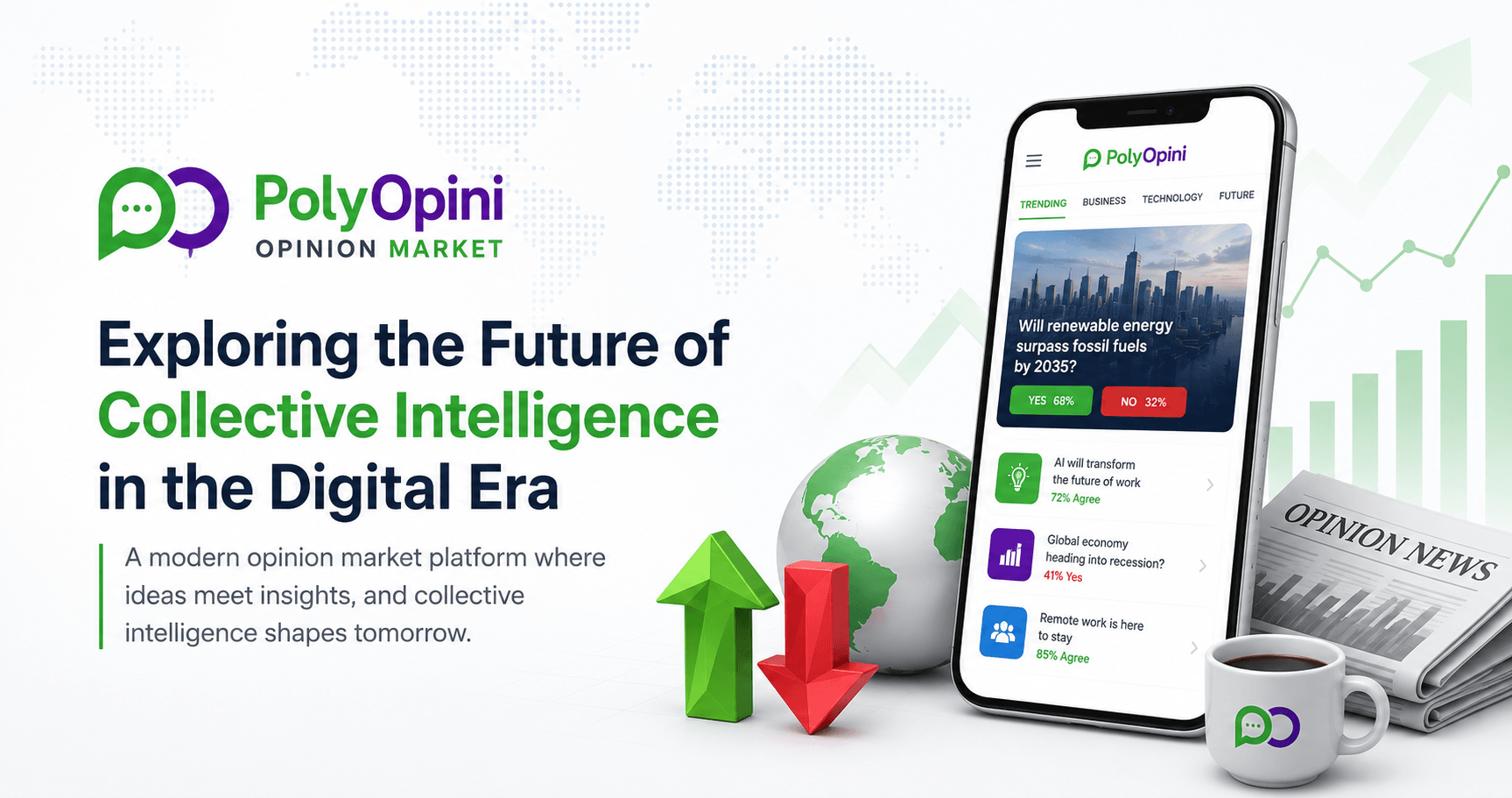
PolyOpini Opinion Market: Exploring the Future of Collective Intelligence in the Digital Era
The digital economy is transforming how people share information, make decisions, and interpret future events. Beyond traditional news platforms and social media, a new concept known as the Opinion Market has emerged as an innovative way to aggregate public knowledge and collective expectations.
Unlike conventional opinion polls that simply collect responses, an opinion market allows participants to express their views through a market-driven mechanism where changing prices reflect evolving public sentiment. As blockchain technology and Web3 continue to mature, opinion markets are gaining attention as powerful tools for forecasting, research, and public discussion.
PolyOpini Opinion Market represents this new generation of digital platforms by encouraging transparent participation, evidence-based thinking, and the collective wisdom of diverse communities.
What Is an Opinion Market?
An opinion market is a marketplace where participants express expectations regarding future events or uncertain outcomes. Instead of relying solely on surveys or expert analysis, it aggregates the knowledge of many independent participants into a continuously evolving market signal.
Participants evaluate available information before supporting one possible outcome. As new information becomes available, market activity adjusts, producing a dynamic representation of collective expectations.
Opinion markets may focus on topics including:
- Global economic trends
- Financial markets
- Technology innovation
- Artificial Intelligence
- Blockchain adoption
- Climate and sustainability
- Scientific research
- Sports competitions
- Entertainment
- Public policy
Rather than claiming certainty, opinion markets provide an additional perspective that reflects how informed participants collectively interpret available information.
Why Collective Intelligence Matters
Every individual possesses different experiences, expertise, and information sources. Economists analyze macroeconomic indicators, software engineers understand technological developments, while industry professionals recognize emerging business opportunities.
When these diverse perspectives are combined through a structured market mechanism, they create what researchers often describe as collective intelligence.
The principle behind collective intelligence is that independent participants, acting on different pieces of information, may collectively produce valuable insights that no single individual could generate alone.
PolyOpini Opinion Market embraces this concept by creating an environment where diverse viewpoints contribute to a continuously evolving picture of public expectations.
The Role of Blockchain Technology
Modern opinion markets increasingly utilize blockchain technology to improve transparency and trust.
Traditional centralized platforms require users to rely on a single organization for transaction processing and data management. Blockchain introduces an alternative approach by recording activities on distributed networks that can be independently verified.
Potential benefits include:
- Transparent transaction history.
- Tamper-resistant records.
- Enhanced security.
- Reduced dependence on centralized systems.
- Greater accessibility for global participants.
These characteristics make blockchain particularly well suited for platforms built around openness and community participation.
More Than Financial Forecasting
Although opinion markets are frequently associated with financial or prediction markets, their potential applications extend much further.
Organizations may use opinion markets to evaluate product demand, estimate project completion timelines, or identify emerging industry trends.
Researchers can study how groups process information under uncertainty.
Technology communities may explore expectations surrounding artificial intelligence, blockchain adoption, or future innovations.
Public institutions may even analyze collective sentiment regarding economic developments, provided such systems operate within appropriate legal and ethical frameworks.
PolyOpini Opinion Market encourages these broader applications by positioning opinion markets as tools for collaborative knowledge rather than merely speculative activity.
Supporting Better Decision-Making
Decision-making often improves when individuals have access to multiple perspectives.
Opinion markets do not eliminate uncertainty, but they provide an additional source of information that can complement traditional research, expert analysis, and statistical forecasting.
For businesses, this may assist strategic planning.
For researchers, it offers insight into collective expectations.
For readers and technology enthusiasts, it creates opportunities to better understand how information evolves over time.
Importantly, market signals should always be interpreted alongside other reliable information rather than treated as guaranteed predictions.
Education Remains Essential
As emerging technologies continue expanding, public understanding becomes increasingly important.
Opinion markets combine concepts from economics, probability, behavioral science, blockchain, and digital finance. Without adequate education, participants may misunderstand how these systems function or overestimate their predictive capabilities.
PolyOpini supports responsible participation by encouraging readers to understand:
- How opinion markets operate.
- The role of probability and uncertainty.
- Blockchain fundamentals.
- Market transparency.
- Independent research.
- Risk awareness.
- Critical evaluation of information.
Educational content helps build a healthier ecosystem where participants contribute informed perspectives instead of reacting solely to speculation.
Encouraging Responsible Public Discussion
Modern digital platforms often reward speed and emotional reactions rather than thoughtful analysis. Opinion markets offer an alternative environment where participants are encouraged to evaluate evidence before expressing expectations.
This approach promotes:
- Critical thinking.
- Evidence-based reasoning.
- Diverse perspectives.
- Constructive discussion.
- Continuous learning.
PolyOpini Opinion Market seeks to encourage meaningful public dialogue by combining technological innovation with responsible participation.
Rather than replacing journalism or academic research, opinion markets can complement them by providing an additional indicator of how informed communities interpret evolving events.
The Future of Opinion Markets
The continued development of Web3, decentralized identity, artificial intelligence, and blockchain infrastructure is likely to expand the capabilities of opinion markets in the coming years.
Future platforms may offer improved transparency, broader accessibility, and more sophisticated analytical tools while maintaining decentralized participation.
As organizations increasingly recognize the value of collective intelligence, opinion markets could become useful across industries including finance, healthcare, technology, scientific research, and public policy.
Their long-term success, however, will depend on responsible governance, regulatory compliance, transparent technology, and informed communities.
Conclusion
Opinion markets represent an innovative approach to understanding uncertainty through collective intelligence and market-based participation. Rather than relying exclusively on individual experts or conventional surveys, they aggregate diverse perspectives into continuously evolving market signals.
PolyOpini Opinion Market reflects this vision by combining blockchain technology, transparent participation, and evidence-based discussion within a modern digital ecosystem. As Web3 technologies continue advancing, opinion markets may become increasingly valuable tools for research, innovation, business intelligence, and informed public dialogue.
Although no forecasting method can guarantee future outcomes, opinion markets demonstrate how collaborative knowledge and responsible technology can contribute to better decision-making in an increasingly connected world.